
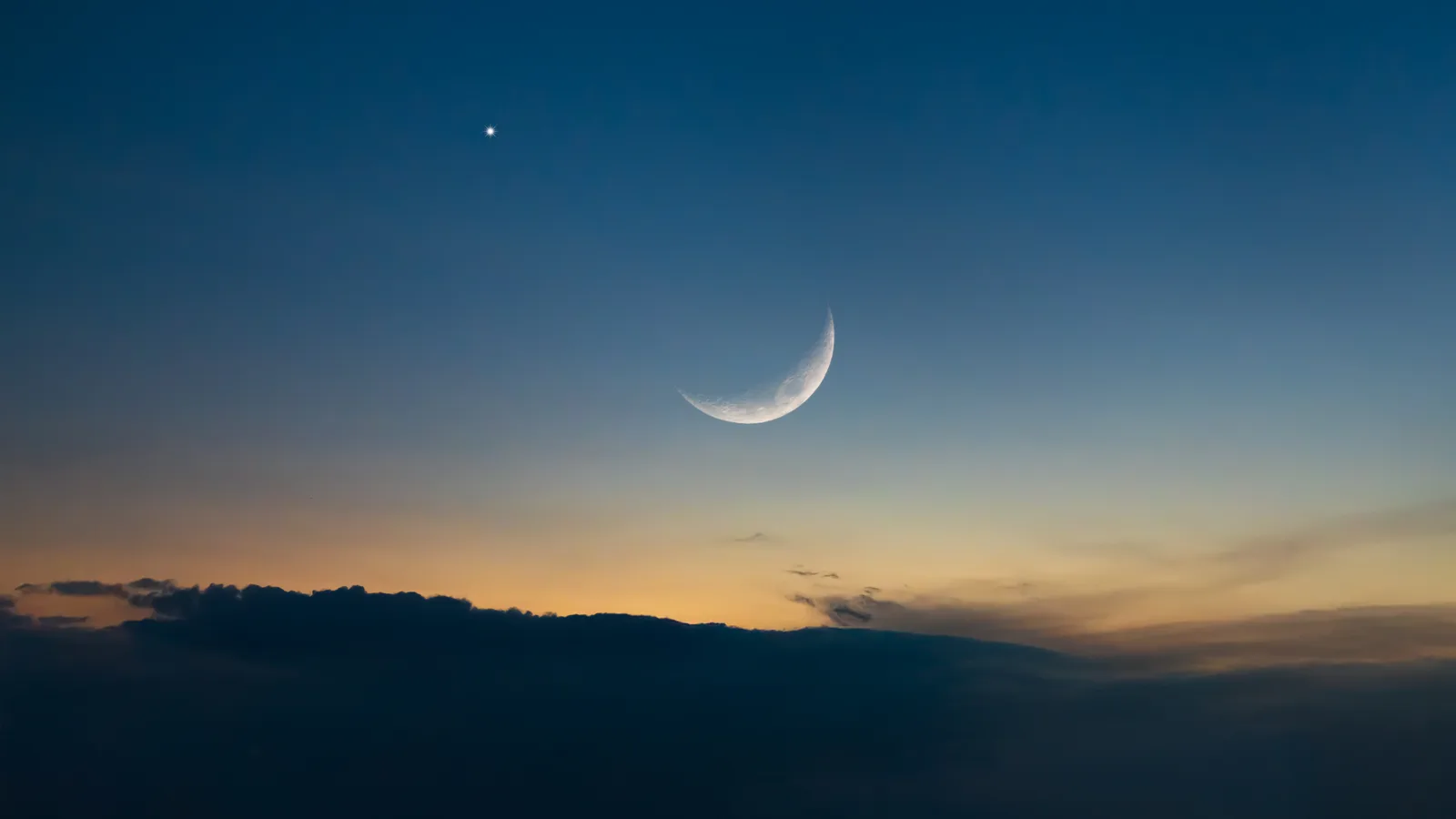
Set an alarm for a little after 4 a.m. Tuesday. Before dawn on October 6, the crescent Moon will slide directly in front of Jupiter, hiding the brightest planet in the morning sky for about 50 minutes, and every city from Jupiter to Homestead sits inside the zone where the whole thing plays out in a dark sky.
When to look, city by city
Astronomers call this an occultation: one body passing in front of another. The Moon drifts eastward against the background sky by about its own width every hour, and on Tuesday morning its path runs straight across Jupiter. The planet does not fade. It sits beside the lit edge of the Moon, touches it, and is gone, then pops back out from the dark edge almost an hour later.
Gold Coast Wave worked out the local times from NASA's Jet Propulsion Laboratory planetary ephemeris, the same orbital data observatories use. Times are Eastern Daylight Time, for the center of the planet:
- Jupiter: disappears about 4:20 a.m., reappears about 5:12 a.m.
- West Palm Beach: 4:20 a.m., back at 5:11 a.m.
- Boca Raton: 4:21 a.m., back at 5:11 a.m.
- Fort Lauderdale: 4:21 a.m., back at 5:10 a.m.
- Miami: 4:21 a.m., back at 5:09 a.m.
- Homestead: 4:22 a.m., back at 5:08 a.m.
Notice the pattern. The farther south you are, the shorter the show, because the Moon's path cuts a slightly shorter line across the planet from down there. Everyone in the three counties gets close to 50 minutes.
Jupiter is not a pinpoint the way a star is. Its disk is wide enough that the Moon takes roughly a minute to cover it completely, and the same on the way out. Be outside by 4:15 so you see the first edge go, and give yourself a few minutes either side of the reappearance.
Where to stand
Face east, a touch toward the north. When Jupiter disappears, the Moon will be about 13 degrees above the horizon, a little more than the width of your fist held at arm's length. By the time the planet comes back it will have climbed to about 23 degrees. That is low enough that a condo tower, a ficus hedge or a neighbor's roofline can block it, so the one real requirement is a clear eastern horizon.
South Florida happens to have the best one in the country: the Atlantic. Anywhere with an unobstructed view out over the ocean works, from a street-end beach access to a balcony on the water. One practical warning: many county and city beach parks do not open until sunrise, so check that your spot is actually open at 4 a.m. before you drive there. Inland, a high parking garage roof or an open field with a low eastern skyline does the job.
Sunrise is not until about 7:15 a.m., so the entire event, start to finish, happens in full darkness. Dawn twilight will not even begin to brighten the sky until well after Jupiter is back.
What you will actually see
With nothing but your eyes, the effect is simple and striking: a brilliant point of light parked against a thin, bright sliver of Moon, and then it is not there. The Moon will be about 20 percent lit, a fat waning crescent, with the lit side facing down toward the eastern horizon where the Sun is still hiding. Jupiter goes in behind that bright side and returns on the dark side, which is the better half of the show, because the planet seems to appear out of empty sky.
Binoculars make it much better. Held steady, even an ordinary pair will show Jupiter as a tiny disk with its largest moons lined up beside it as faint pinpricks. A small backyard telescope will show the planet's cloud bands as the lunar edge slices across them. Brace binoculars against a car roof or a railing; at that magnification every heartbeat shows up as a wobble.
If you want to photograph it, a phone on a tripod will capture the pairing before and after, though the planet will mostly read as a bright dot. A long lens on a mount is what captures the moment of contact.
The forecast
The National Weather Service forecast for tonight calls for partly cloudy skies across Miami-Dade, Broward and Palm Beach, with light south winds and a low in the upper 70s. The chance of showers is concentrated in the evening hours and again Tuesday afternoon, not in the predawn window. Partly cloudy is not perfect, but the event lasts nearly an hour, and a passing cloud bank only has to clear once at the right minute.
Why it is worth losing sleep over
The Moon passes in front of Jupiter somewhere on Earth fairly often. Getting one where you live, high enough in a dark sky to actually watch, is another matter. Running the same ephemeris for Miami across six decades turns up a surprise: the last time the Moon covered Jupiter here in a properly dark sky was December 7, 2004. The next one does not come around until the night of May 9, 2038.
So the odds are good that anyone in South Florida who is not up early tomorrow will be waiting about 12 years for the next chance. Make a thermos of cafecito, find a patch of east-facing sky, and watch the Moon swallow a planet before the morning commute.
Loading comments…