
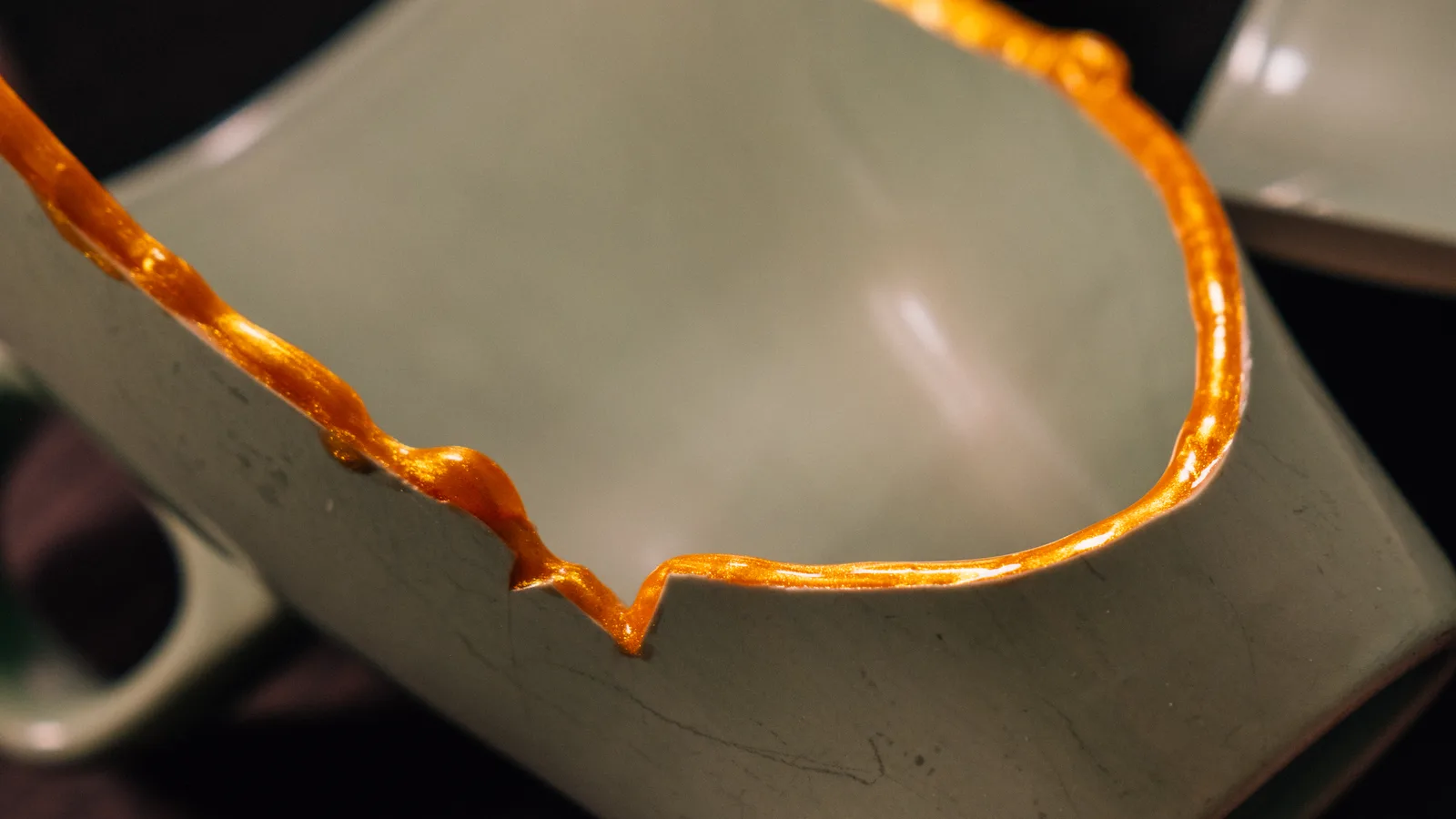
A bowl made in Persia somewhere between the 10th and 14th centuries now sits in a gallery west of Delray Beach, its cracks traced in 23.5-karat gold. It is one of more than 160 pieces in Mending Cracks in Time: Kintsugi Art of Naoko Fukumaru, which opened to the public on Oct. 17 at the Morikami Museum and Japanese Gardens and stays up through Feb. 28, 2027.
Kintsugi is the Japanese practice of repairing broken ceramics with natural lacquer, made from tree sap, mixed with powdered gold. The method dates to 15th-century Japan, and its point is the opposite of an invisible repair: the seams are left bright so the history of the break stays part of the object. The Morikami describes the tradition as both a craft and a way of looking at damage, and the exhibition is built around that second idea as much as the first.
A conservator's hands, an artist's choices
Fukumaru came to this work from museum conservation. According to the Morikami, she worked as a ceramic conservator at major museums in the United States and Japan, which gave her a close working knowledge of how ceramic, lacquer and metal behave together. In this show she pairs that technical background with pieces shaped by her own experience of recovery.
The range of what she mends is wide. The museum lists master ceramic works, tea ceremony utensils, everyday vessels, imported wares, pieces that came out of the kiln deformed, and one installation piece. Several of the works on the museum's exhibition page show how far she stretches the material list:
- It's Okay to be Broken starts with that Persian stoneware bowl, about 7 inches across, restored in 2023 with calcium carbonate, lacquer and gold.
- Secret Life is built from excavated stoneware fragments from Heinz Laffin Pottery in Canada, and its repair materials include barnacles alongside the lacquer and gold.
- Beautiful Trauma, Rango, restored this year, joins a pre-Columbian double vase fragment with raku ceramic fragments, resin, brass and blackberry thorns.
The Morikami produced the exhibition itself, with support from the E. Rhodes and Leona B. Carpenter Foundation, and in part from the Canada Council for the Arts.
Try it with a hammer on Nov. 7
The museum also runs a hands-on adult workshop, Introduction to the Art of Kintsugi, taught by Claudia Henao, a glass and mixed media artist with more than 25 years of experience. The next date is Saturday, Nov. 7, with a single session from 10 a.m. to 12:30 p.m. in the Oki Education Center. Further sessions are on the calendar for Jan. 14, Jan. 30, March 11, May 6 and June 12, 2027.
The workshop costs $70, plus a $50 materials fee paid in cash to the instructor. Ceramic pieces are provided, but participants are asked to bring a small hammer, an apron, a stack of newspaper, a dust mask, safety glasses and a box at least 12 by 12 by 4 inches to carry the finished piece home. Classes are for ages 15 and up, advance registration is required, and museum admission is included with programs over $35, so a workshop ticket also covers the galleries and gardens that day.
Two more shows in the building
Visitors who come for the kintsugi can see two other exhibitions on the same ticket. Dancing Brush: The Art of Calligraphy, a selection of 19th- and 20th-century Japanese calligraphy including seven hanging scrolls, runs through Nov. 29. Clifton Karhu: An American in Kyoto shows woodblock prints, ceramics and stone works by the Duluth, Minnesota, native who moved to Japan, wore a kimono daily, played the shakuhachi flute and became the first non-Japanese artist admitted to the Japan Print Association. All of the Karhu works come from the museum's own collection, and that show runs through Jan. 17, 2027.
Outside, the Morikami's Roji-en garden takes in six distinct historical Japanese garden styles, along with a bonsai collection. The museum is heading toward its 50th anniversary, which it will mark with a Golden Gala on March 6, 2027.
What: Mending Cracks in Time: Kintsugi Art of Naoko Fukumaru
When: Through Feb. 28, 2027; museum and gardens open Tuesday through Sunday, 10 a.m. to 5 p.m., closed Mondays and major holidays
Where: Morikami Museum and Japanese Gardens, 4000 Morikami Park Road, Delray Beach
Cost: Included with admission: $18 adults, $16 seniors 65 and up and military, $14 college students, $12 ages 6 to 17, free for ages 5 and under and members. Kintsugi workshop Nov. 7: $70 plus $50 materials
Info: 561-495-0233
Loading comments…