
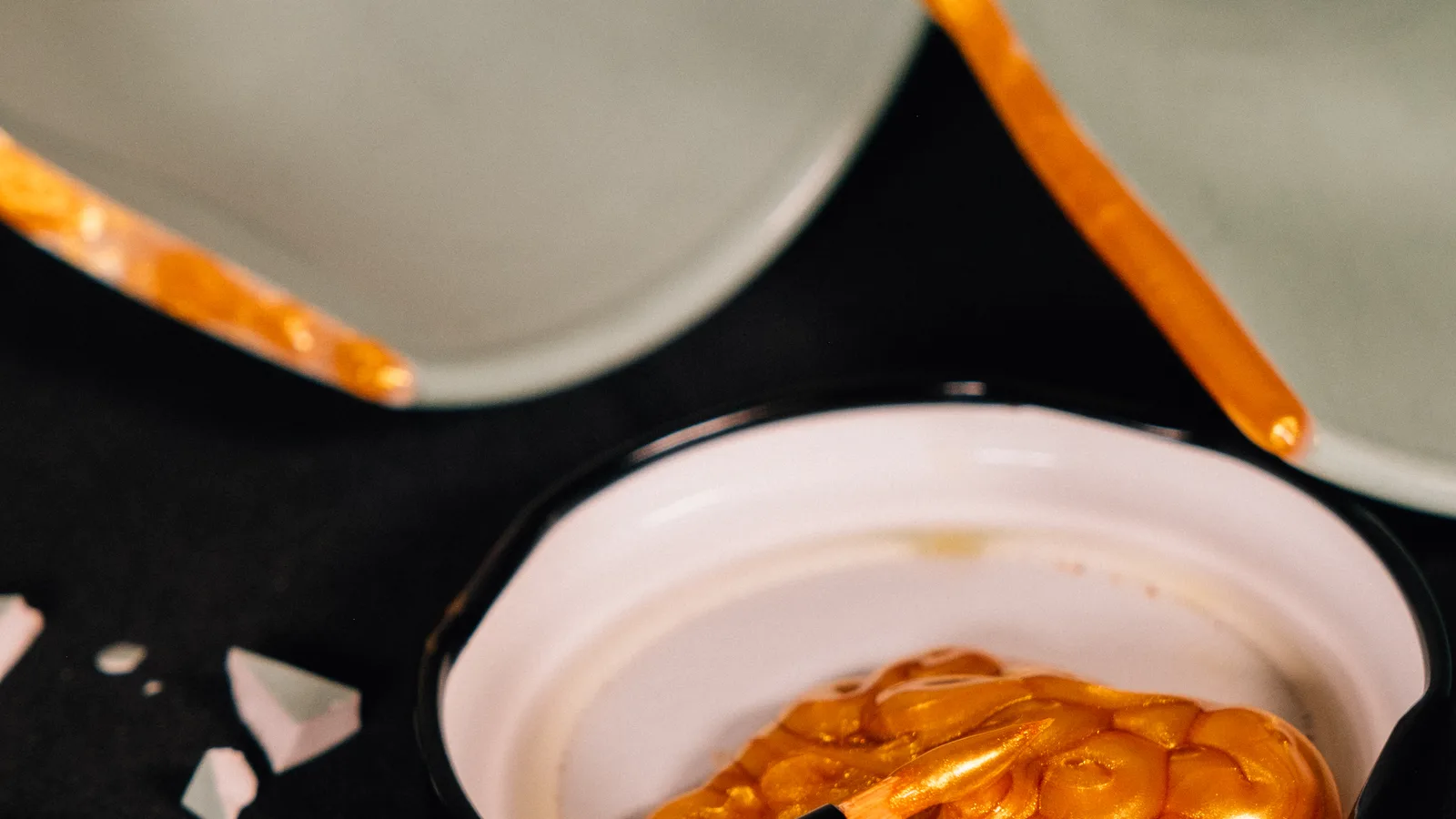
A piece of Persian stoneware made as much as a thousand years ago, restored with lacquer and 23.5 karat gold. Excavated pottery fragments from Canada, rejoined with gold and barnacles worked into the repair. Starting Saturday, October 17, more than 160 pieces like these go on view at the Morikami Museum and Japanese Gardens in Delray Beach, in an exhibition built entirely around the Japanese art of repairing what is broken and letting the repair show.
What kintsugi is, and why the gold matters
The show is called Mending Cracks in Time: Kintsugi Art of Naoko Fukumaru, and it runs through Sunday, February 28, 2027, with a member preview day on Friday, October 16. Kintsugi is a practice that goes back to 15th century Japan. A cracked or shattered ceramic is put back together with urushi, a natural lacquer made from tree sap, and the seams are dusted with powdered gold. The point is the opposite of a careful invisible fix. The break becomes the most visible thing about the object, traced in a bright line across the surface.
In Japan that idea carries a philosophy as much as a technique: the damage is part of the object's history, so you honor it instead of hiding it. Morikami frames the exhibition the same way, as a room meant for thinking about loss, resilience and recovery, and it is a fair bet that a lot of visitors will walk out thinking about something in their own lives that cracked and held.
The artist is a conservator first
Fukumaru did not come to kintsugi as a hobbyist. According to the museum, her professional background is in ceramic conservation at major museums in the United States and Japan, which is the kind of work where you learn exactly how clay, lacquer and metal behave over centuries. That training shows in what she chooses to mend. The 160 plus items in the show range across master ceramic works, tea ceremony utensils, everyday dishes, imported wares, pieces that warped in the kiln, and a single installation piece.
The individual labels are where the show gets surprising. Among the pieces Morikami has published:
A Persian stoneware piece dated somewhere between the 10th and 14th centuries, restored in 2023 with calcium carbonate, lacquer and 23.5 karat gold. A fragment of a pre-Columbian double vase, rebuilt with lacquer, resin and gold. Excavated stoneware fragments from a pottery in Canada, joined with lacquer, resin and gold, with barnacles worked into the repair. And raku ceramic fragments put back together with lacquer, resin, brass and, of all things, blackberry thorns.
That range is the reason to go. Kintsugi is most often associated with Japanese tea bowls. This exhibition carries the method to objects from Iran, the pre-Columbian Americas and Canada, and lets unexpected materials like barnacles and thorns become part of the mend.
Morikami's 50th year
The exhibition lands in a milestone season. Morikami is marking fifty years as a cultural bridge between the United States and Japan, and its Golden Gala is set for Saturday, March 6, 2027, with a lakeside dinner and a finale of floating lanterns on Morikami Lake. The kintsugi show will close a week before that, so the fall and winter are the window.
It is worth remembering how the museum came to be in western Delray at all. As Morikami tells it on its history page, the Yamato Colony was a small community of Japanese farmers established in 1905 on land in what is now northern Boca Raton, along the road that still carries the colony's name. Most settlers left within a generation. George Morikami stayed, farmed, and eventually spent years trying to give his land away for public use. Palm Beach County accepted the gift in 1973, and it became Morikami Park.
Two other shows on the walls right now
Mending Cracks in Time will share the museum with two exhibitions already open. Clifton Karhu: An American in Kyoto, on view through January 17, 2027, features woodblock prints, ceramic and stone works by a Minnesota-born artist who moved to Japan and became the first non-Japanese artist admitted to the Japan Print Association. Dancing Brush: The Art of Calligraphy, through November 29, 2026, gathers hanging scrolls, fans and the brushes and ink used to make them, all from Morikami's own collection. Details are on the current exhibitions page.
Put together, a single visit this fall covers gold-mended ceramics, modern Japanese printmaking and centuries-old brushwork, with the gardens outside on top of all of it.
Planning a visit
Morikami is at 4000 Morikami Park Road in Delray Beach. The museum and gardens are open Tuesday through Sunday from 10 a.m. to 5 p.m. and closed Mondays and major holidays. Per the museum's hours and admission page, tickets are sold at the door on the day of your visit: $18 for adults, $16 for seniors 65 and up and military with ID, $14 for college students with ID, $12 for children 6 to 17, and free for children 5 and under and for members. The Cornell Café serves Tuesday through Sunday from 11 a.m. to 3 p.m., which makes a late morning arrival and lunch by the lake an easy plan.
Members get the first look on Friday, October 16. Everyone else can walk in from Saturday, October 17.
Why it is worth the drive west
Plenty of museums show beautiful objects. Fewer show beautiful repairs, and fewer still put Persian stoneware that may be a thousand years old, mended in gold, a short drive from Atlantic Avenue. For anyone in Delray, Boca or Boynton who has meant to get back to Morikami and kept putting it off, a show about mending things that broke, opening in the museum's fiftieth year, is about as good a prompt as you will get. Go on a weekday morning when the gardens are quiet, see the gold up close, and give yourself time afterward on the paths.
Loading comments…